Showing posts with label economic threshold. Show all posts

Friday, April 11, 2014

How to read the updated economic threshold table for alfalfa weevil

I recently posted an ICM News article about how scouting for alfalfa weevils in southern Iowa. It doesn't take too many accumulated degree days for them to start moving around and laying eggs. If you grow or scout alfalfa, you will likely see any adults that survived the winter moving in southern Iowa now and northern Iowa next week. In the article, I show an updated economic threshold table based on work from John Tooker at Penn State. It has a lot of numbers in it, and at first, looks kinda confusing. In order to make cost-effective treatment decisions for alfalfa weevil management, three things must be known:

1. what is the expected market value of the hay ($/ton)?
2. how much are the control costs ($/acre)?
3. how tall are the plants (inches)?

Take that information and plug it into the table below. Well, I guess you have to actually go out to the field and sample larvae before consulting the table! The larvae are often tucked into stems and expanding terminals. Pull at least 30-50 stems from different areas of the field and madly shake them into a 5-gallon bucket to dislodge them.


Alfalfa larva (top) and adult. Photos by Clemson University, www.ipmimages.org.

Economic threshold of alfalfa weevil, based on the average number of larvae in a 30-stem sample (Originally published by JohnTooker, Penn State Extension).

In case the table is still confusing, I highlight two examples. Example 1 (look at the orange arrows):  if you are expecting $260/ton, control costs of $14/acre, and plants are 20 inches tall...the economic threshold would be 40 larvae per 30-stem sample. In other words, if you sample 30 stems and get at least 40 larvae, consider taking some management action to protect tonnage and hay quality. Example 2 (look at the red arrows):  if you are expecting $380/ton, control costs of $12/acre, and plants are 28 inches tall...the economic threshold would be 24 larvae per 30-stem sample. In other words, if you sample 30 stems and get at least 24 larvae, consider taking some management action to protect tonnage and hay quality.


Monday, August 20, 2012

Updated bean leaf beetle thresholds

Summer is winding down fast, but some areas in Iowa still have respectable numbers of bean leaf beetle. The second generation is coming out and could cause direct injury to soybean pods. If your beans are still developing, it might be a good time to go out and take some sweeps.

 Bean leaf beetles can be confused with southern corn rootworm and other beetles. Look for four dark spots on the forewings, and a dark triangle behind the "neck." Photo by Marlin E. Rice. 

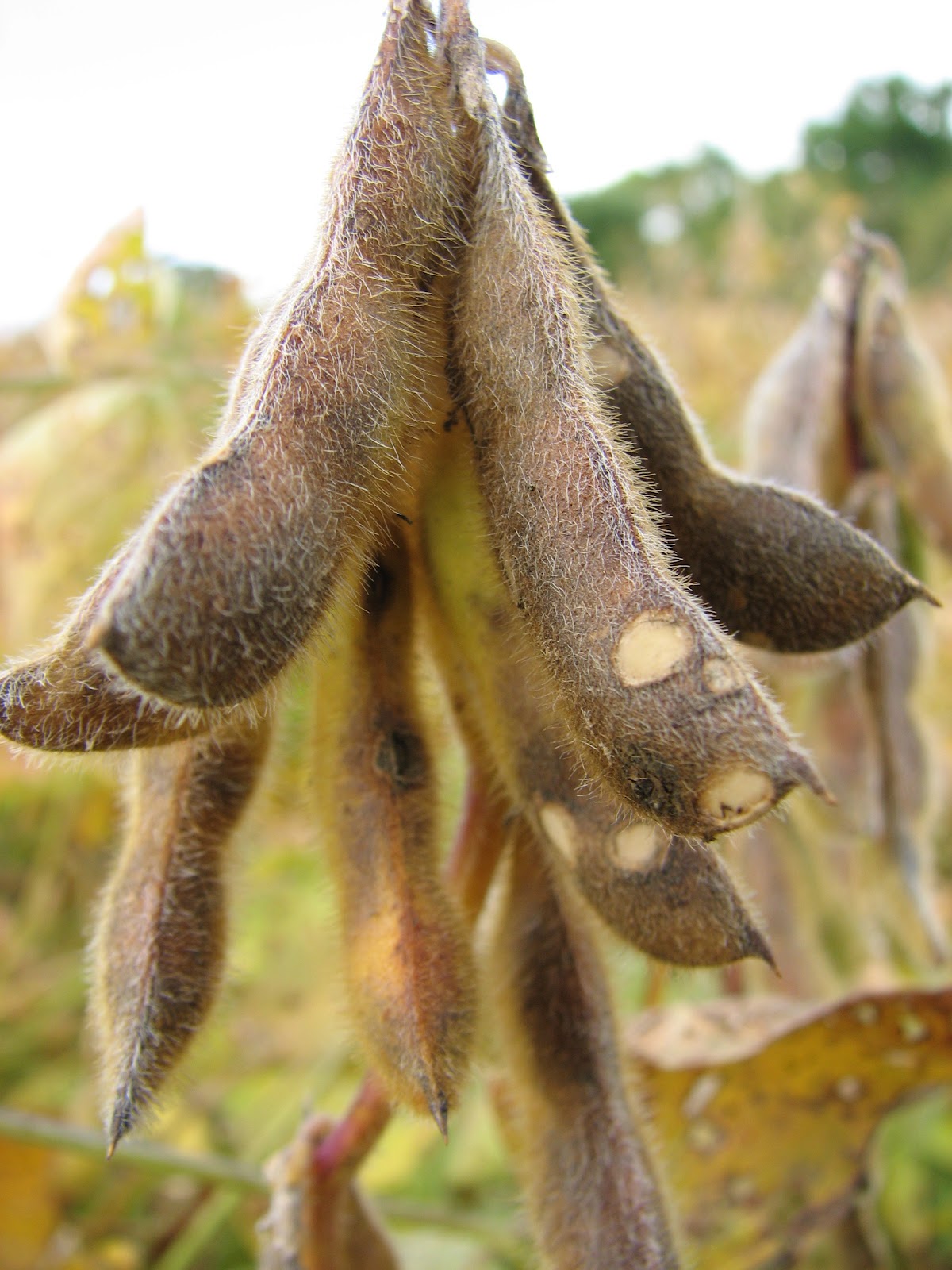
Overwintering and first generation bean leaf beetles rarely cause direct economic damage to soybean in Iowa; plants compensate for defoliation in many ways. But they can transmit bean pod mottle virus that can impact the market value of food grade soybean. Bean leaf beetle can cause direct injury to pods during the seed fill stage depending on when the second generation emerges. 

Bean leaf beetles can eat about 0.2 pods per day. Note they don't eat all the way through the pod, like grasshoppers can. Photo by Mark Licht, ISU Extension. 

Last year I had several questions about treatment thresholds for bean leaf beetle given our higher market values. With the help of ISU entomology grad student, Mike McCarville, we created a dynamic threshold calculator. It's a downloadable Excel file where you plug in your market value and control costs. Visit this ICM News article and scroll to the bottom for the link the calculator. To learn more about bean leaf beetle biology and management, click here.